



Vietnam's Energy Transition
Social-Ecological Transformation, Vietnam | 30.03.2016
Vietnam's Energy Transition
Will not be displayed!
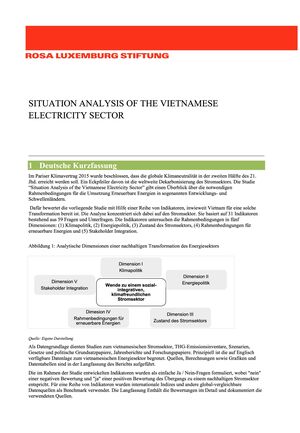
The study at hand gives an overview of the framework conditions for a transition towards a socially inclusive renewable energy based electricity sector in Viet Nam. The Paris Agreement 2015 states that peaking of global emissions has to occur as soon as possible, and that climate neutrality has to be achieved in the second half of the 21st century.
The decarbonisation of the electricity sector is a corner stone for climate neutrality and since key technologies are available already, decarbonisation is much easier than for other emission sources. While allowing economic development and increasing electricity supply - this study considers renewable energy to be the adequate tool to sustainably decarbonize the power sector.
Using a series of indicators, this study assesses the readiness for an energy transition and a low carbon pathway in Viet Nam. Even though the transport and heat sections of the energy sector are relevant for greenhouse gas (GHG) emissions, our analysis concentrates on the enabling environment of the electricity sector. The study evaluates to what degree Viet Nam is prepared to move towards sustainable energy, and identifies barriers that exist for a start towards an energy transition.
Situation Analysis of the Vietnamese Electricity Sector
Publisher: Rosa-Luxemburg-Stiftung Southeast Asia Hanoi Office
Author: Christine Wörlen & Sarah Rieseberg
Date: March 2016
Pages: 93
Download: English version (includes a summary in German)